
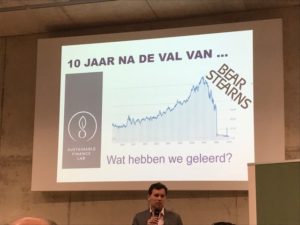
The Sustainable Finance Lab (SFL) hosted a crowded and highly animated meeting on 14 March, which reflected the decade since the start of the financial crisis. For insiders, most of the issues were perhaps known. But to me, it was surprising that there was so much explanatory weight attached to imbalances in the financial and economic system as such in relation to the cause of the crisis. Imbalances which, moreover, so far persist and are greater in our own country than elsewhere. That is certainly disturbing.
This became clear to me from the introductions of the professors Dirk Bezemer and Dirk Schoenmaker. In particular, it concerned endogenous credit growth and debt shifting from goods and services to capital markets. This financialisation of the economy and its associated development towards a more speculative system leads to greater inequality and polarisation in society, greater volatility, instability and fragility. The underlying causes cannot be properly addressed. It has to do with our character as a retirement nation and our highly developed service-oriented economy. The dampening of the increasingly extreme vibrations of the economic cycle will have to come to a large extent from government regulation. At the heart of this is the tame of credit growth, including by increasing banks' mandatory own capital ratio. All speakers (former and current bankers, supervisors and politicians) agreed on this.

But that's certainly not enough. The morality of the financial sector also needs to be strengthened. The question is to what extent government regulation can help to do this, or perhaps even in certain ways, because it provokes legalistic behaviour. Moreover, government interventions always go after the facts (think of fintech development that was strangely not mentioned by anyone) and there is mainly political attention to incidents. Herman Wijffels rightly raised another pressing issue. How can we ensure that all this accumulated capital will be used more for meaningful societal purposes in the coming years, such as the transitions needed in the light of the ecological crisis? This calls for investments that yield (possibly) lower financial but much higher social returns. The embedding of the financial sector in the triangle market, government and society is essential to this. This is also the theme of the Sociresprogramme Finance and the Common Good And it was central to our Conference on 23 January. Together with the Sustainable Finance Lab, we want to continue working on this in the future.