

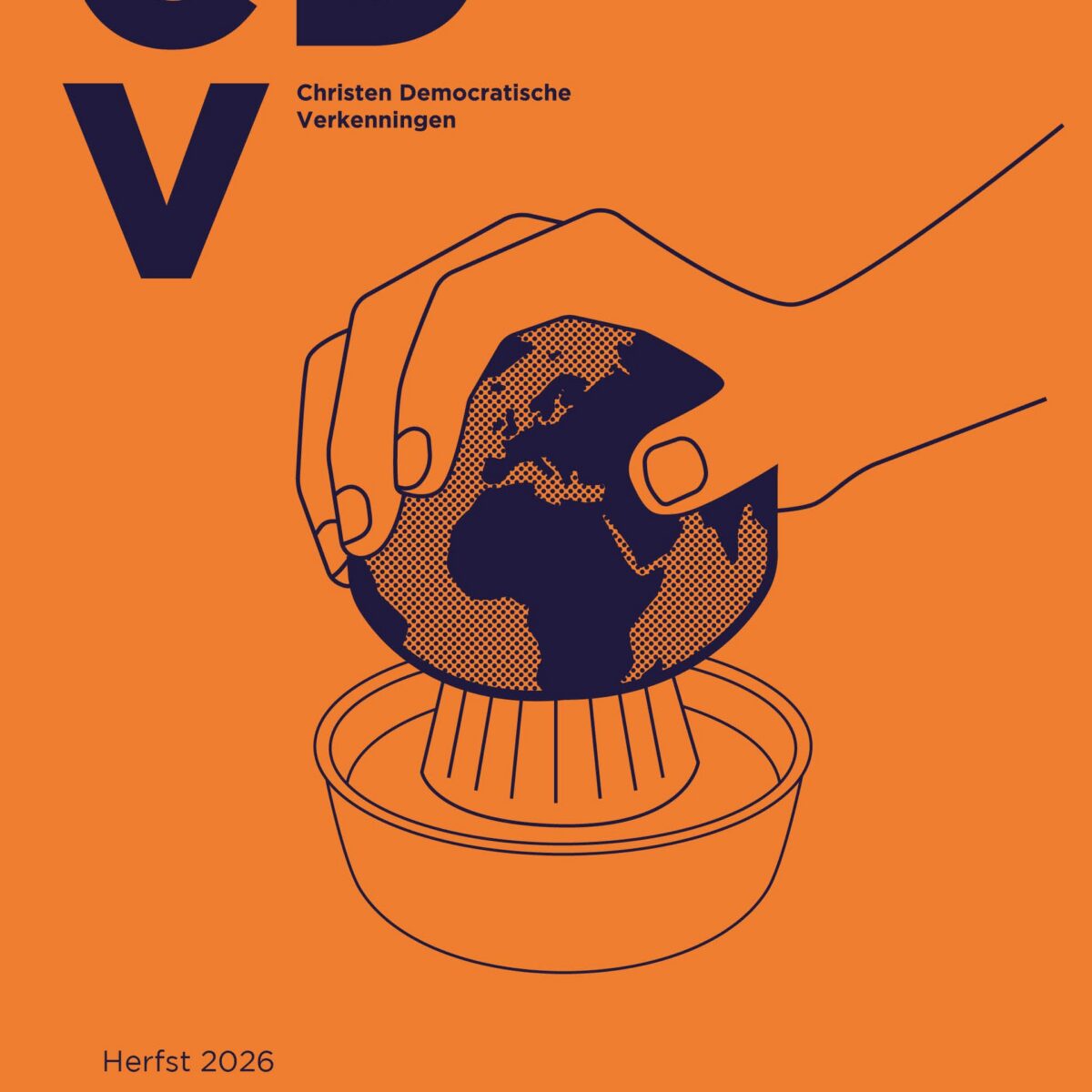
In the autumn edition of Christian Democratic Explorations (CDV) this year, Mr van Steden writes about why radical-right parties in Europe are gaining ground and why popular parties like the CDA are losing ground.
The current rise of the radical right in Europe has many causes, but above all it needs a fruitful breeding ground. Catherine de Vries, professor of political science at the IE University of Madrid, is convincingly exposed in her latest book. The symphony of discontent. However, you can also ask the question differently: not what explains the rise of radical right, but what the decline of popular parties. Pepijn Corduwner, as historian and associate professor at Utrecht University, asks this question in his Rise and decline of the popular parties. In this article both books are discussed from the question of what insights mean for (the future of) the CDA.
The article can be read below and on the website of the CDV via the following link:
Journalcdv.nl/Why-there-little-hope-glow-for-CDA
Ronald van Cities · Christian Democratic Explorations, autumn 2026
Last summer we rented a house near a small, sleepy place in the middle of France. Where exactly doesn't matter. There are so many towns and villages in the country. I saw what many Dutch love: the charm of messy old streets and houses, the French battle, the quiet rhythm of life. But I felt something different at the same time. Pleasant feelings of nostalgia, melancholy even, which summoned the place to me, are awfully close to a sneaky abdominal pain caused by decay, loss and discomfort.
The center of the town must have been lively and cozy. Now many shops are empty, the hotel (big priced) is for sale and dangles the broken sign of the Pharmacie Sad to a rusty brace. Posters almost begged to apply to open vacancies for a general practitioner. Only at the edge of the hypermarché It's busy. What stands out: especially seniors push their carts through the endless aisles full of products. Younger generations seem to be outnumbered. Rassemblement National (RN) received a third of all votes in previous elections.
Emergence of radical right
The current advance of radical right in Europe has many causes: Social media and influencers that broadcast a repetitive message of untrustworthy "woke" elites and toxic solutions of "remigration," the genius and charisma of populist leaders, and the functioning of national electoral systems. All that will be true. However, a fertile soil is needed to ensure that such factors can flourish. Catherine de Vries, professor of political science at the IE University of Madrid, is convincingly exposed in her latest book. The symphony of discontent. She grew up in Overijssel, where from the end of the 1980s public services began to swell: The police station closed, the bus drove less often and schools were merged. Her now deceased father lost to excess of disaster his farm, became disappointed in government and politics, and switched from loyal CDA supporter to a fixed voice at the PVV.
De Vriessijn frank family story, supplemented by international data, hits a sensitive string that I also heard resonating in France. Supported by a laundry list of scientific literature, De Vries shows similar trends in the Netherlands, France, the United Kingdom, Italy and Germany. Drive by car to the Eifel in a few hours, and you can see the same decline and drain of some craft villages. It is not even necessary to travel all the way to the east to understand the popularity of the AfD, although the presence of this party is undoubtedly the greatest. According to the German Institute, it is more than a protest vote. The party actually has something to offer to the electorate. Politicians are known as police officer, teacher, soccer coach or member of the voluntary fire brigade.1 As such, they are committed to local entrepreneurs, children's playground or energy supply. With great electoral and political success and the promise of even stricter asylum policy.
De Vries rightly writes that her analysis has a bit of a mystery story. Especially in the Netherlands, municipalities have generally not fallen, we are among the richest countries in Europe, and our life expectancy is high. Widely-based unrest does not therefore have to correspond at all to the actual situation, which is more rosy in our country than it suggests.2 Then where did this discrepancy come from?
De Vries points to five forms of deviation that have made public provision: less money (the library closes), more distance (a hospital is further away), less quality (neighborhood agents are barely visible in their neighbourhood), more thresholds (wrapped forms and long queues) and less attention (professionals no longer have time to listen to people). In short: The government has gradually withdrawn from everyday life, creating increasing public discontent.
Radical-right-wing politicians blow up this sense of loss and decline in Europe and then point to elites and migrants as root causes. Thus, a legitimate concern about the apparent decline in public services is turning into an emotional charge, while policies aimed at austerity, efficiency and privatisation continue without delay. The image of the French hypermarché who pushes the butcher, baker and grocer out of their shops, leaving city centers desolate, completes the sad picture. Of course there are political, economic, cultural and historical differences between the countries that De Vries has investigated. Yet the same false melody sounds everywhere. Right radical politicians put promises of recovery into their hands loss experiences and stories about scapegoats.
More and more voters are enchanted by their message. Diffuse social discontent is the fundamental tone. Social media, talk shows and middle parties that take over positions act as amplifiers.
Putting right-radical politicians to their hands with promises of recovery loss experiences and stories about scapegoats
Popular party decline
You can also tell the story from the other side. Then the question is not what explains the rise of the radical right, but what caused the decline of popular parties, specifically the Social Democrats and Christian Democrats. Pepijn Corduwner, as historian and associate professor at Utrecht University, asks this question in his Rise and decline of the popular parties. In the Netherlands De Vries also does this in her book. However, Corduwner points out that the liberals are a middle party, but not a popular party. Social and Christian Democrats, with their roots in nineteenth century mass movements, are. They started as spokesmen of disadvantaged groups, but turned into connecting parties that were open to everyone and sought political and social stability. Their mission continued until the late 1960s. Then, according to Corduwener, it gradually came into play.
He distinguishes three pillars on which popular parties supported. First of all, they were deeply rooted in social networks of newspapers, associations and churches, in the case of Christian Democrats, all over the country. Secondly, popular parties tried to unite broad groups, thereby counteracting polarisation. And finally, politicians and directors were prepared to transcend the interests of the parties, to compromise and to bear government responsibility. In his historical analyses of the Netherlands and elsewhere, Corduwener comes to conclusions similar to those of De Vries. He stressed the need for financial reforms due to the economic crises in the 1970s and 1980s. The welfare state threatened to become too expensive and uncontrollable. In their urge to make the government leaner, popular parties are focusing on their unique capacity to do this job. They had administrative responsibility. Meanwhile, however, politicians lost sight of what drastic cuts in public services meant for the . Social and Christian Democrats lost touch with society, which itself also changed greatly through processes of secularisation, globalisation and individualisation. In addition, parties engaged in pragmatic politics so much that they forgot their ideological differences, turned into professional boards of government and became unrecognizable to the original grassroots. Throughout Europe, membership and voters fell. So fills
People's parties cut off their own seats
Corduwener points out that in the Netherlands the degeneration was not without political consequences: The CDA's popularity dropped accordingly.
Moreover, membership of associations, the social environment with which popular parties were closely linked, is steadily decreasing. Was still 70 percent member in 2012, in 2024, this number remained at 62 percent. The decline is visible in almost all population groups, but the strongest among 25- to 35-year-olds, people with origin outside the Netherlands and those with lower incomes are reported by CBS.3 Add to this the loosening of philosophical affinity with popular parties, and it is understandable why they have fallen into severe weather. The connecting power of both public facilities and social networks has been eroded, causing pillars of support among popular parties to shake. Some of them cut off their own seat legs.
It should be noted that the crumbling of public services and the shrinking social fabric of associations, clubs, churches and cooperatives are mutually influenced. In the last part of her book, De Vries argues that the shrinking association life, the less stable number of memberships and the non-binding nature of volunteering have increased pressure on the government. Not everything, however, can be placed on the sign of public services: the police, the general practitioner and the construction worker. De Vries: A close government does not demand more money or centralism, but space for civil society. By cutting red tape, ensuring stable funding and providing practical support to civilian projects, collective action is made possible that stimulates public presence, even if the formal government is less visible.
Public facilities, neighbourhood initiatives and cooperative relationships are investments in people, time, meeting and trust
Now what?
The power of popular parties lies in the political and social centre. But yes, that center has moved to the right, witnessing all the anti-migration rhetoric that sounds there. It also runs through political fragmentation on the flanks. The CDA's electoral revival is pleasant, but offers no guarantee of lasting success. I've already pointed it out: De Vries recommends that popular parties opt for a government that feels close and strongly organized: [...] efficiency combined with real proximity; digitally where you can, personally if you have to. Public amenities, community initiatives and cooperative relationships are not just cost items, but also investment in people, time, meeting and trust. They form the backbone of society and can contribute to a re-evaluation of the social union. Physical and symbolic proximity to public debt and collective debt is part of the DNA of a resilient democracy. That should appeal to the CDA, at least theoretically.
The pressing problem: People's parties that have been promoting efficiency and pragmatism for decades, a government that has withdrawn and a civil society that sighs under overdue maintenance are not just changing course. De Vries and Corduwener, each from their own perspective, see this very clearly, with the latter showing themselves pessimistic. The decline of popular parties is too deep and now goes back too far. Pim Fortuyn's lightning-fast rise in 2001 is a turning point, but the decline of social and Christian Democrats has occurred since the 1970s and is accelerating. An answer doesn't seem to be in sight. Are we going to face a democracy without popular parties? Does that weaken the democratic system? Or is searching, doubting and experimenting with new forms of political enterprise precisely the power of that same democracy? In any case, Corduwner finds speculation on a lasting revival of the popular parties to be unrealistic.
De Vries warns that moving along with radical right over the bow of anti-immigration policy is unwise. Popular parties tend to do this, not popular parties. Nevertheless, I think that the CDA should take seriously the concerns that society has about migration. In a critical reply to the book by De Vries in The Correspondent Jesse Frederik wonders if under the erosion of public services there is not a much simpler cause for the rise of radical right-wing, namely sincere and widely shared discomfort over rising migration rates.4Within our "Diploma Democracy" there are considerable contradictions between a progressive, usually highly educated group, which favours openness, diversity and inclusion, and a more conservative group, which wants to protect their country. Although reasons for the latter may be questionable, it is very important that both groups remain in conversation, as people understand each other less and less.5 The CDA has the difficult task of telling a binding story in polarized times.
It's five to twelve for popular parties like the CDA
With a Community Fund, the CDA aims to strengthen the social link in society from below.6 The millions of euros released for this certainly offer opportunities, but such a fund also looks quite abstract and technocratic. Then the AfD does it smarter, by focusing mainly on what AfDunkers locally do to tangible things: Troubleshooting, organizing a neighborhood party. Connecting people to you means delivering concretely, not meeting too long. Popular politicians have well understood that having an eye for such an everyday thing as proximity, attention, dignity, broadly supports the population. De Vries and Corduwner learn that it is five to twelve for popular parties such as the CDA, unless they are able to reconnect with the citizen. Or is it too late already?
Notes
- Marja Verburg and Wiebke Pittlik, .Why East Germany votes massive AfD, website Germany Institute, 27 February 2025. See https://dutlandinstituut.nl/article/62502/why-east-German-mass-ad-votes ↩
- See also: Ronald van Cities, we got it right, but we feel bad. Christian Democratic Explorations 46 (2026), No 1, p. 128-132. ↩
- Daniëlle Groffen and Moniek Coumans, Developments in the association life Statistical Trends, December 11, 2025. See www.cbs.nl/en/longread/statistical-trends/2025/development-in-union life ↩
- Jesse Frederik, "Freemed but true: the most plausible explanation for the rise of radical right-wing is also the least popular pedigree, The Correspondent, May 21, 2026. See https://decorrespondent.nl/16937/foreign-but-where-the-most-plausible-statement-for-the-coming-of-radical-right-is-also-the-least-popular/db53b0ac-265b-0837-3ad0-f8683e63a232 ↩
- Ronald van Cities, is the Netherlands getting grimmer? Skipper 38 (2025), No 2, p. 28-32. ↩
- The CDA election programme 2025 states that the party wants to invest in a Community fund to maintain facilities such as community centers and sports accommodations; see CDA, Build on trust. Our choices for a decent country. The Hague: CDA, 2025, p. 11. This plan has also been incorporated into the coalition agreement; See D66, VVD and CDA, Let's go. Building a better Netherlands. Coalition agreement 2026-2030. The Hague, 30 January 2026, p. 10. ↩
