

On May 13, 2024, the symposium 'Ecological Citizenship' took place as part of the biennial series "De Nalatschap" by Ruud Lubbers, with which special attention has been paid to his legacy since the death of the Dutch former Prime Minister. The symposium in The Hague focused on the socio-cultural dimension of the sustainability transition, focusing on issues of justice, responsibility and the demand for good living together.
Henri Bontenbal (CDA) and Jeroen Klumper (Tata Steel) held the referee and co-repherate. Jan Schinkelshoek provided a spoken column. In conclusion, a panel discussion took place with Alex Datema (Rabobank), Kathleen Ferrier (UNESCO) and Marije Klomp (Radboud University). Moderator was Jan Peter Balkenende and the symposium was concluded by Josine Westerbeek-Huitink.
Click below to look back on YouTube:
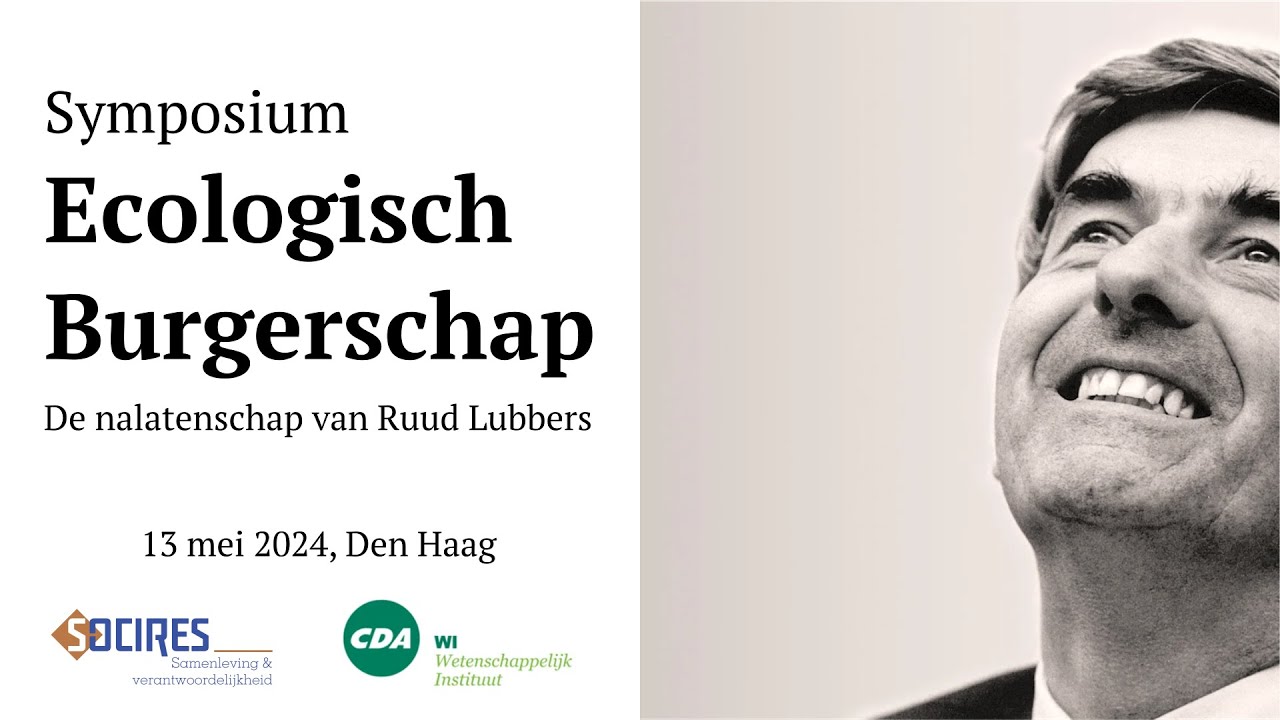
This video recording was made possible by the Dr. Abraham Kuyper Fund, for which we thank you.
The lectures are also available in writing:
• Henri Bontenbal on Ecological Citizenship (PDF)
• Column Jan Schinkelshoek (PDF)
Background
Solar panels, heat pumps, electric auto-sustainability transition takes shape in our society. The question is no longer whether we want to organise our society differently, but to do so best, supported by citizens. The climate issue is not just a technological or economic issue, it is mainly a social one.
The ecological transition confronts our society with issues of justice, responsibility and the demand for good living together. Pope Francis therefore pleaded in his encyclical Laudato Siūn for re-ecological citizenship: the balance between man and nature, society and ecology and between innerness and culture.
How can we promote this ecological citizenship? What does this require of society, business and politics? And what does this mean for the way in which public administration is directed? This was at the Lubbers symposium.
Lubbers and Eco-Citizenship
For Lubbers, sustainability played an important role. During his political career he was progressive in the area of sustainable development: He paid attention relatively early to the potential of renewable energy and the demand for economic growth within planetary, ecological boundaries. Lubbers also had a leadership role in the creation of the Earth Charter, a global movement that advocated attention to the (interlinked) issues of human rights, equality, peace and ecological integrity.
The symposium was organised in collaboration with the Scientific Institute for the CDA. For more information please contact us socires@socires.nl.