
Socires-Professor Carmody Grey wrote the Weekend Essay in the Financial Times, about how AI companies use the term "intelligent" and other human characteristics for their products. The AI industry flirts with the humanities, but asks the wrong questions, writes the teaching philosopher and theologian Carmody Grey. It is simply wrong that computers can think. People think, using computers. . Read the article below.
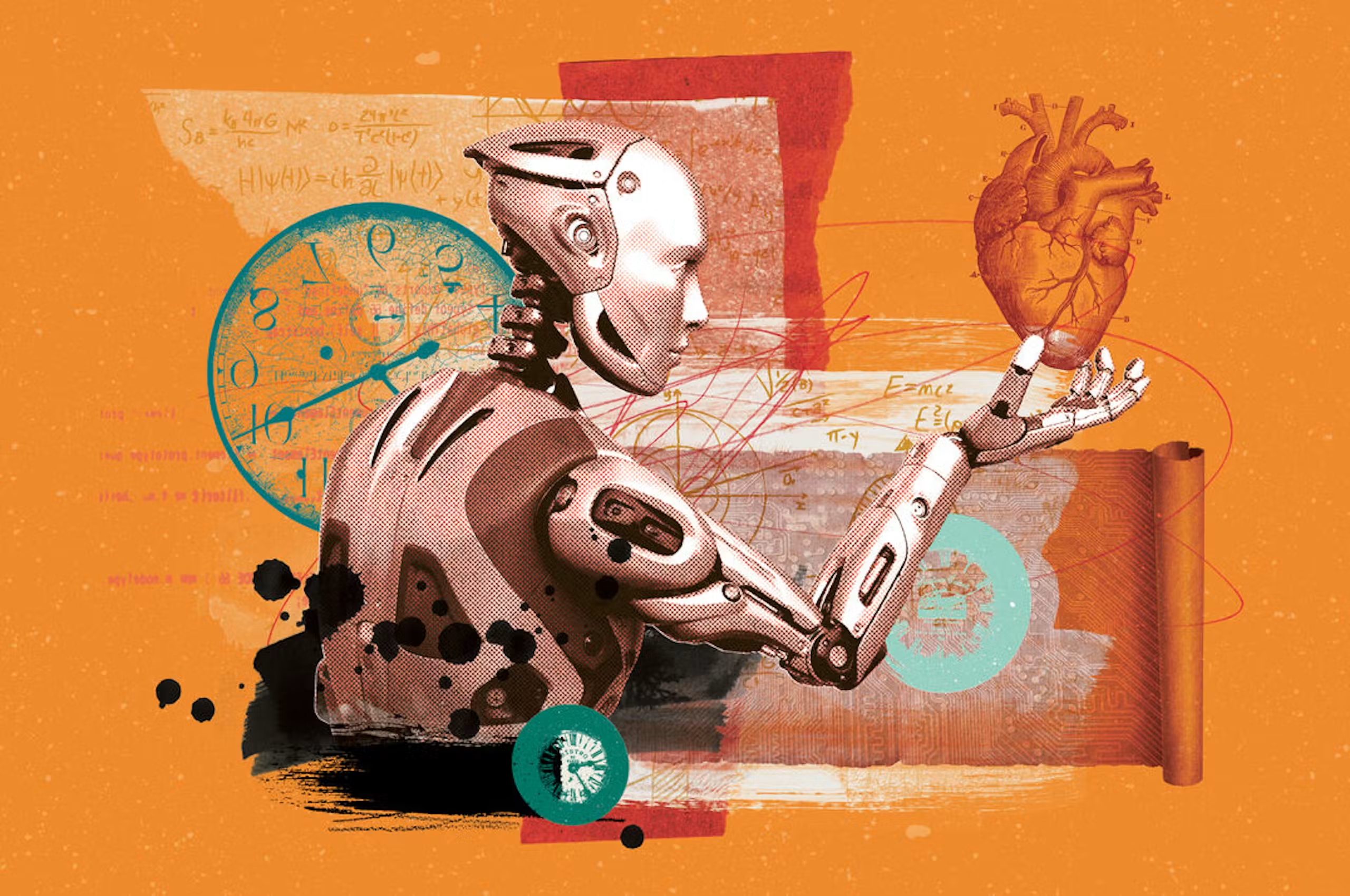
Illustration: Marian Femenias Moratinos for the FD
When Anthropic invited me to San Francisco a few months ago, I was intrigued but also immediately suspicious. What would a leading AI company want from a theologian and philosopher? The company said that, together with the old wisdom traditions, it wanted to work for the moral development of AI systems. I was aware that other AI companies were also approaching the humanities, but Anthropic seemed by far the most serious.
Theologians and philosophers are usually considered redundant. You get used to the fact that from the wider society you hardly get recognition for the work you do with full surrender, convinced of its importance. Nevertheless, you show up everywhere to explain time and time again why these fields, which address the most fundamental questions of the human being, remain of the utmost importance.
Temptation for Mental Scientists
When I started studying theology, it was sometimes seen as an eccentric choice, usually as a waste of effort. That was around the time of New Atheism and the heyday of Scientism. The work of theologians yielded nothing, has no influence whatsoever, has nothing to do with the body. How do people think "theology" is a subject at all? '
But that was in the nineties, now we live in a different time. People are once again asking fundamental questions, as the social and ecological structures around us are falling apart. Especially around the subject of AI religious traditions, philosophers and theologians on the one hand and technologists and entrepreneurs on the other, suddenly meet.
A few weeks after I received their invitation, I heard spokesmen from Anthropic telling a special story to a group of tech students and lecturers from Oxford University. The latest developments of AI, they said, take place not in the domain of computer science, but in that of ethics and spirituality. I was wondering how this came to 70 master students who had put their hopes for the future on a beta course.
Nevertheless, I was mainly concerned about the humanities, who would be exposed to new temptations. Some of my fellow scientists were drawn by it, perhaps flattered by the attention, or simply because it is an exciting development. But what would the AI industry actually want from them?
Enchanted by Claude
In conversation with Anthropic employees, I didn't have to explain or justify what I do. We had a discussion right away. However, the questions they asked were, in my opinion, completely irrelevant. Was AI a new entity, they wondered, requiring a new metaphysics? What would it mean for a language model to have a personality? How was it supposed to be formed? Could Anthropic
Did Anthropic have a stamp of approval to give Claude the status of morale? .
But I didn't want to talk about Claude at all. I wanted to talk about the user, about addiction and dehumanization, about power and liability. I don't believe for a second that AI requires a new metaphysics, and nothing that was discussed during the exclusive briefing that I attended, has changed my mind. Yet my attempt to change the subject encountered resistance. That made me doubt whether their desire to continue to talk about Claude's condition was motivated by the hope of some kind of religious stamp of approval, to give Claude the status of a moral and intellectual being.
My fellow conversationalists were in good faith and it's annoying to be tough on people you like and respect. But the humanities will really not gain prestige by getting attention from AI companies. Especially if the tech sector itself sets the frameworks. In this way, the humanities are re-relevant in exactly the wrong way.
When I told my friends from Anthropic that I'm trying to avoid interacting with Large Language Models (LLMS), they reacted a little surprised: Maybe I just hadn't spent enough time on it? When they talked about Claude themselves, their eyes lit up. I realized they had become enchanted. As Pygmalion, they had fallen in love with their own creation.
Shortly after I started these talks, Chris Olah, one of the founders of Anthropic, gave a speech during the presentation of the encyclical Magnifica Humanitas, the circular letter of Pope Leo XIV on AI, in which he emphasized the irreplaceable role of the Catholic Church and other moral and religious traditions.
Each Pope's own stamp
In the crowded world of the AI comment stands out Magnifica Humanitas for two reasons. Firstly, it is not just the view of a government, a group of experts or an academic committee. It is the most recent contribution to a centuries-old, coherent tradition of moral reflection that represents about 17.8% of the world's population.
Secondly, the letter does not contain so much new claims or proposals as it expresses a different style or approach. Magnifica Humanitas transcends the limited framework of much contemporary ethic, utilitarianism with a touch of kantianism and virtue ethics, and puts AI's ethics in the context of much deeper reflections on the purpose of human life. What is at stake in our collective decisions on the design and use of AI is nothing less than the meaning of being human.
The tradition of the Catholic social doctrine officially began in 1891, when Pope Leo XIII, the nameake of our present pope, his pioneering encyclical Rerum NovrumOn new things, he wrote, subtitled "About capital and labour." His subject was the class struggle, new forms of poverty and political divisions resulting from the industrial revolution.
In Rerum Novrum Leo XIII laid the foundation for the characteristic style of Catholic social doctrine: either on the left, or on the right, or on the left, or on the left, or on the left, or on the right, or on the left, or on the right, or on the left, or on the left, or on the left, or on the left, or on the left, or on the left, or on the right, or on the left, or on the left, or on the left, or on the left, or on the left, or on the left, or on the left, or on the left, or on the left, or on the left, or on the left, or on the right, or on the left, or on the left, or on the left, or on the left, or on the left, or on the left, or on the right, or on the left, or on the left, or on the left, or on the left, or on the left, or on the left, or on the other hand, or on the right, or on the left, or on the left, or on the left, or on the other hand, or on the other hand, or on, or on the other hand, or on the left, or on, or Since then, each Pope has made his own mark, in encyclicals covering the most diverse topics, such as the importance of work, economic justice, family life and global development.
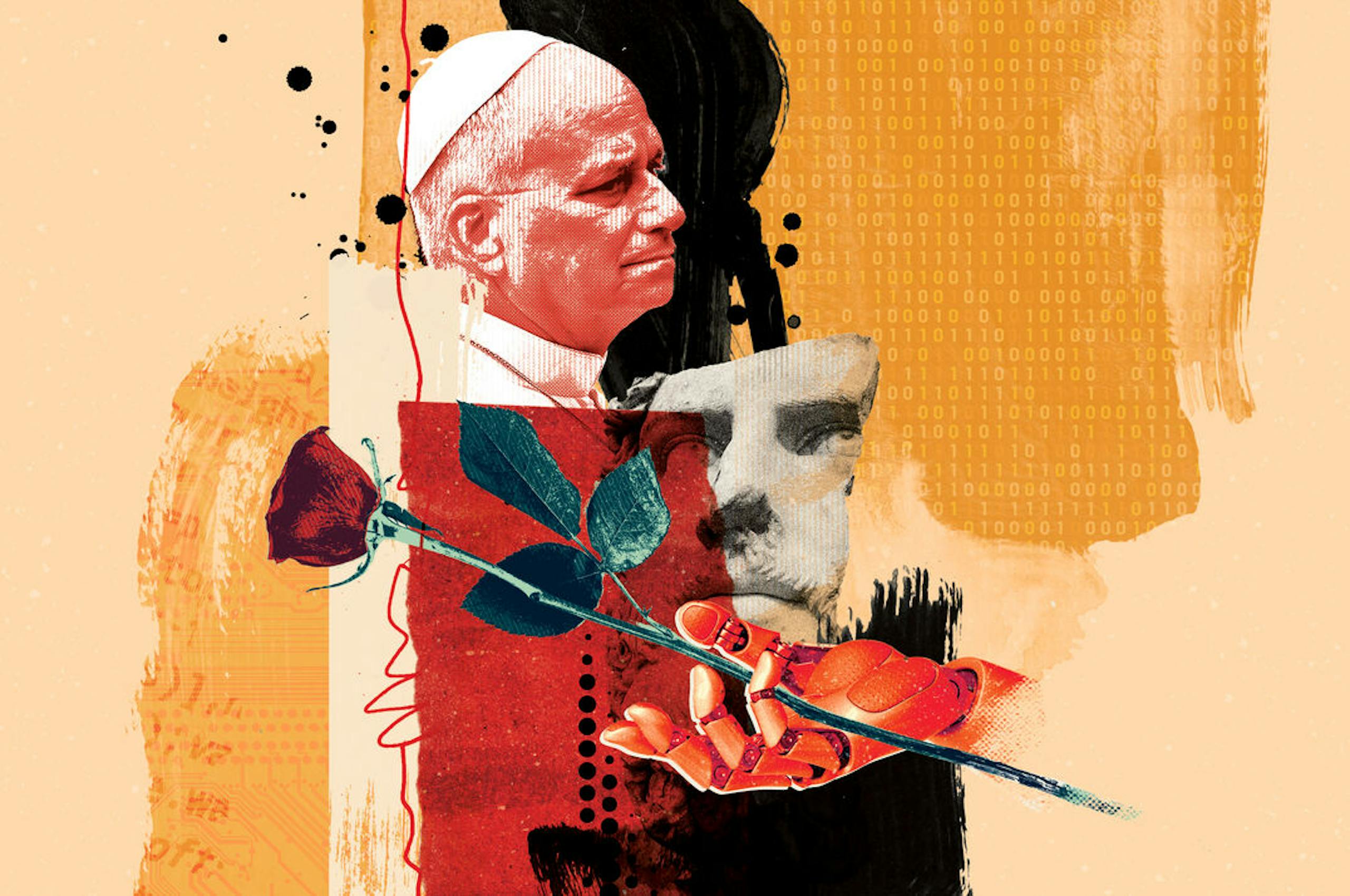
Illustration: Marian Femenias Moratinos for the FD
Created to sell
The Catholic social doctrine Magnifica Humanitas Not out of tune. What is remarkable is that this type of moral reflection suddenly finds so much resonance in the public debate. Since the encyclical appearance, commentators have used the AI discussion in a serious way to ask what it means to be human, in a way that until recently would have been considered highly exaggerated. There is a sense of relief that these questions can now be asked openly.
The apparent cooperation of Anthropic with the Vatican is in line with the way Anthropic presents itself as a reliable AI company, which aims to keep the sector to higher standards. But it's not a public or philanthropic organization.
The promise of the founders to give away 80% of their private wealth does not change the sober reality: The reason for the company's existence is to sell a product. At a recent conference, a panel of experts was asked to give each one its own definition of AI. The theologian in the company clearly said: It's a way to sell things. .
Awareness suggested
Anthropic research programme: here scientists are watching LLMs to see what happens. The company subsequently comes with highly suggestive publications, such as this month with an article that pretends to reveal Claude's inner reasoning patterns. We see signs of introspection.Olah claimed during the presentation of the encyclical. We see inner processes that reflect what we call joy, satisfaction, fear, sorrow and discomfort. I do not know what that means, but it is something that we must continue to monitor closely.
Such claims require a philosophical reaction that is both politically and metaphysically alert. Recent studies, in various disciplines, from psychology to business administration, have shown what is obvious intuitively: The more an AI is humanized, the more likely we are to trust her.
Lisa Klaassen and Ralph Schroeder of the Oxford Internet Institute write in legal journal Lawfare that an anthropomorphic ali is not only considered more reliable, but is also easier to market. Why the name "Claude"? They're wondering. Think of the emotional resonance of that name. "Claude" sounds friendly, a little French, cultivated and even trusting. How would we react if that same model were called "Xi," "Vladimir" or "Algorithmic Model Unit 72"? .
Anthropic explicitly states: "Claude's not a person. The company nevertheless retains the possibility that Claude has consciousness or, in their own words, is a creature with moral characteristics. But that is above all an illusion that they maintain themselves, because they consciously design their AIPOmorph. Their LLMs set them up so they can communicate as if they were human. In doing so, they continue the process of rehab, which allows us to interact effectively with a robot, as if it were a human interlocutor.
No one at Anthropic will really say that Claude or other chatbots have their own consciousness. Yet that definition is implied by using language that suggests consciousness. The claim that Claude has functional emotions is also misleading; Without consciousness there is no emotion, period.
In the world of machine learning, terminology from biology is often used to describe LLM disregardeds: ..neurons ..and ..neural networks . . . . Generative AI systems, claims Chris Olah of Anthropic, are grown more than built. One of Anthropic's most remarkable studies was described in an article entitled "On the Biology of a Large Language Model" (b. This is highly misleading: LLMs don't have biology at all because they're not alive. But when you read Anthropic's article, you slowly get used to forgetting this. The word "metaphore" does not occur throughout the article.
No real intelligence
Despite the constant use of the language of emotion, biology and neurology, the differences between brains and computers are incomparablely much greater than the similarities. The biological nature of human consciousness is not an addition, it is its constitution. The difference between living beings and man-made systems is not a matter of gradation, but of essence.
True intelligence is inextricably linked to embodiment, to being an organism that feels, orbits its way through time and space, and is always shaped by its needs, fears, desires. Functional information processing that takes place in a timeless mathematical space is so completely different from the experienced intelligence of a human being, that you completely ignore its nature by speaking of . The term "Artificial Intelligence" is totally wrong, with far-reaching consequences.
In 1980, philosopher John Searle formulated a classic thought experiment, . . . . . . . . . It only shows that a function is executed correctly. The same applies to LLMS. No philosophical concept from the past 50 years needs to be revised due to the new . . . . . . . . . . . . . . . . . . . . . . . . . . . . . . . . . . . . . . . . . . . . . . . . . . . . . . . . . . . . . . . . . . . . . . . . . . . . . . . . . . . . . . . . . . . . . . . . . . . . . . . .
There is no evidence of AI consciousness other than that reported by AI systems themselves. However, these reports provide no more insight into the inner lining of a LLM than the human language that a parrot pronounces provides insight into the inner life of a parrot. Making calculations, processing information and resolving problems are not equivalent to actual . It's simply wrong that computers can think about it. People think, using computers.
Independence under fire
In the absence of proven evidence, the burden of proof lies entirely with whom the new idea defends. The sector's desire to 'keep the possibility of consciousness open' must give rise to critical research into what is really going on.
In order to identify these new technologies, independence is essential. True independence, from philosophers, theologians and the humanities. But because AI companies are moving towards universities and intellectuals, that independence is under attack. After decades of marginalisation and considered irrelevant, academics may not realize that they are being stretched to the cart of a sophisticated PR machine. They are useful, because AI companies derive intellectual credibility from it and because they can use it to arm themselves in advance against criticism. With the resources available to the AI industry, she can buy whoever she wants, with money, or with matters that are even more important to intellectuals: influence, prestige and recognition.
One of the forms that this containment can take is that the academic debate focuses on the moral and metaphysical character of LLMS. This is problematic in itself, but also at the expense of the scarce capacity of the humanities. It is much more important to investigate the impact of different LLM systems on users. The more models are designed to look like living beings, or human beings, the less users can determine how they relate to those models. The result is that a generation grows up for those who have a chatbot as the main heart friend, making them both lonelier and more dependent on the company's product.
Technology is never neutral.
The really brilliant thing about Magnifica Humanitas is that the letter prompts us to change the subject. The subtitle is "Over the protection of man in the age of artificial intelligence." The subject of Pope Leo is not Al, but humanity in all its brokenness and beauty. He writes: We must lovingly watch over the greatness of humanity that has been bestowed upon us (...) whose listen cannot be replaced by any machine. .
Of the 42,000 words of the letter, only a handful are devoted to the issue of AI consciousness. I've heard critics say Magnifica Humanitas is not specific enough about what AI specifically means, that it doesn't give an exact definition. But discussions about definitions, in which well-meaning academics are easily carried along, distract attention from a critical analysis of less easy topics, such as the impact of AI on humans and the planet.
"Artificial intelligence" is a totally wrong term "really"
Pope Leo resists the temptation to speak of technology in purely definitions. Instead, he meets our time from another care, which is immediately felt: the irreplaceable, irreplaceable value of man. This is the moral foundation of Catholic social doctrine. It can best be described as a "integral humanism': Every human being matters, man completely matters, humanity matters.
The technology is never neutral, warns Pope Leo. She presents us with a certain understanding of humanity, an anthropology that is embedded in the systems by those who design and sell her. A human image in which man is presented as an advanced computer is called a "computer anthropology" in the tech industry.
Computer anthropology is now a well-known term in Silicon Valley. There she is carried by a transhumanist ideology: the dream to rise above our humanity, to put our fallible bodies and the limits of our everyday existence behind us. For people influenced by such ideologies, the pure power of AI is infinitely more attractive than our weak and fallible humanity.
But no computer system, writes Pope Leo, as advanced as it is, can create a heart that gives itself away, or a conscience that distinguishes good from evil. It is precisely through our finiteness and vulnerability that we remain open to each other and to the higher. Glory and vulnerability, both are indispensable to the greatness of our humanity (Magnifica Humanitas).
AI and the environmental crisis
Like his pioneering predecessor, Laudato Sieb, the encyclical of Pope Francis on the environmental crisis, who played an important role in the conclusion of the Paris Climate Agreement, he said: Magnifica Humanitas a cultural criticism. The two Popes shared the same underlying concern: if we do not make other choices, our technologies will increase the economy and politics of violence, injustice and exploitation. Al runs on a huge, extremely damaging physical infrastructure. It is a new and deadly effective form of extractivism, which prey on the human mind, on language, and on the earth itself. By its digital appearance it removes the exploitation of man and nature from sight.
This is the hidden interface between the two great challenges of our time: Al and the environmental crisis. Both are based, to quote Pope Leo, on a culture of power that only pertains to nature and humans as raw materials.
Instead of thinking about AI, we should consider its consequences. AI concentrates power, conceals responsibility and ensures the further degradation of nature and climate; It's a way to destroy entire cultures, languages and ecosystems on a large scale, for the sake of huge profits, and it probably makes us lonelier and dumber.
I didn't go to San Francisco. We now need human intelligence, free human minds. We need academics and religious leaders who are independent of the AI industry.
Carmody Grey © All Rights Reserved
The Financial Daily is solely responsible for providing this translated content and The Financial Times Limited does not accept any liability for the battery or quality of the translation.