Becoming independent of Big Tech an impossible task? In a new essay in META, journal for library & archive, David Oldenhof-Boks and Hans-Dieter Hiep show that an audience and democratic alternative is possible. And the key is surprisingly close: the local library. Below the whole article. The article can also be found on the website of vvbad. be.
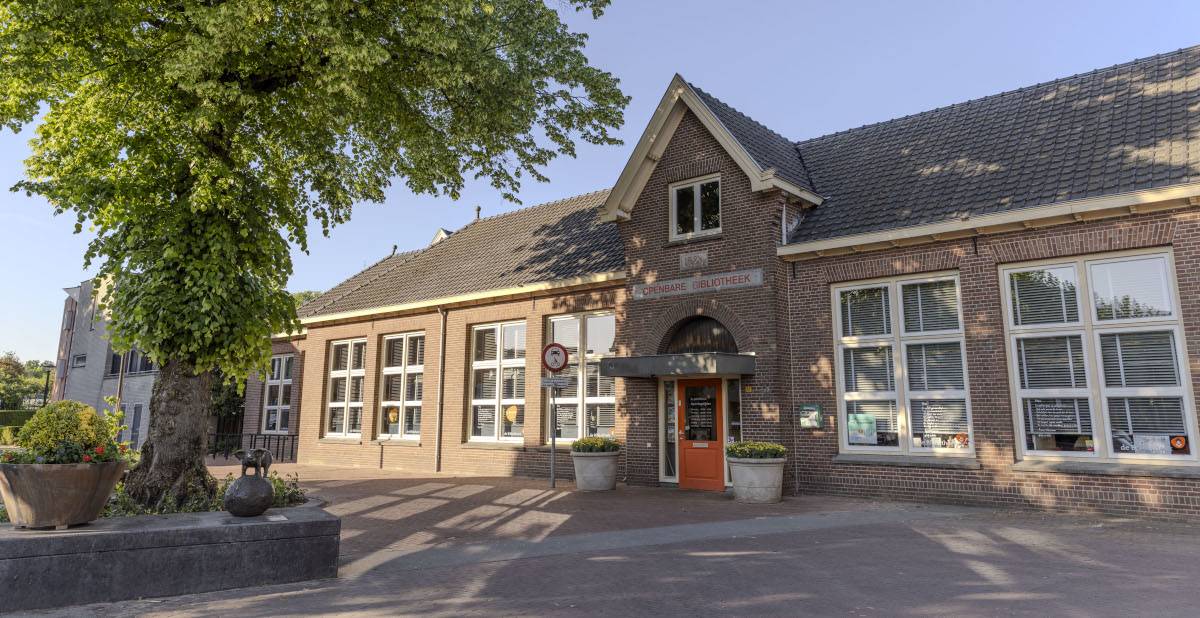
The public library in Twello. © Lilian van Rooij
The Internet is broken
The Internet is a critical infrastructure that we all depend on. Currently, the Internet is largely owned by a few private American tech companies. The close cooperation between the Trump II government and Silicon Valley has finally opened Europe's eyes to the enormous vulnerability associated with this dependence.
Young people are particularly affected: the use of social media platforms has negative side effects, particularly on the mental well-being of young people. Reports show that the lifetime happiness of young users has suffered a severe dent in the last few years. The main cause is the earning model behind big tech: keep the attention of the user as long as possible, present as many ads as possible, and collect personal data to sell.
Artificial intelligence (AI) uses that data to model and anticipate human cognition, but also to select much more targeted targets for specific content. Therefore, social media is becoming increasingly interesting to state actors, as it provides automated and personalised propaganda channels. The Internet can be deliberately used by states and big tech to undermine democracy. In today's hybrid warfare, that is a cheap and simple way to cause chaos and disruptions.
These structural problems are more well known, and many parties are already working on solutions. In this article, we advocate that European public organisations, including public libraries, cooperate more closely on an alternative Internet that we manage ourselves. This can be done by organising the Internet on a decentralised basis (European, national, regional and local), with democratic participation and local ownership. An internet based on European values such as federal cooperation, open source, privacy and security. For example, the Internet can serve public upliftment and thus a vital society.
An internet based on European values such as federal cooperation, open source, privacy and security. For example, the Internet can serve public upliftment and thus a vital society.
An alternative internet from the library in times of great geopolitical tensions
The high dependence on foreign . . . . . . . . . . . . . This also affects our countries, regions and neighbourhoods. In the early 2026 Dutch households received a government brochure in the mailbox containing information on how to prepare for an emergency. This is an addition to the recommendation to bring in an emergency package and cash in case of disaster. Disasters can happen by chance (by ignorance of man or by a natural phenomenon) or can be deliberately caused. Secretary-General of NATO, Mark Rutte, even says that we must prepare ourselves spiritually for a war situation. The message is clear: we need to prepare better to cope with a crisis.
The Dutch government brochure mentions a place in the neighborhood where people can meet when there is no internet or electricity at home, and so there is no communication. A place where the government provides information, and where people can communicate with the government. The public library is the logical place for this. This builds on her current social role: Most libraries have an Information Point Digital Government (IDO) and from 1 January 2027 municipalities in the Netherlands have a legal duty to provide library facilities to all residents. Libraries are critical infrastructure. Also in the corona period they are designated as such, while during the corona period we assumed that home would always stay connected to internet and electricity: an idea that no longer has any certainty about and which we are better prepared for.
People have a strong need for contact with each other and with their relatives during crises. According to Dr. Jori Kalkman, crisis management expert, people have two basic needs during an emergency: meet each other and get information. During last year's power outage in Spain and Portugal, people were particularly in need of greater clarity, as demonstrated by research by the Netherlands Institute for Public Safety (NIPV). Knowing that you can go to the library for information and communication helps to remove fear and reduce the feeling of vulnerability.
People have a strong need for contact with each other and with their relatives during crises.
In the ideal situation, a library support point is also a place where people not only come to get something, but also bring something. Many residents want to mean something to another in times of crisis, so an emergency support point in the library is a means to facilitate that and to organise neighborly assistance. In case of a disaster, a library can also act as a local command post.
Technological foundation of a backup network
Identifying libraries as emergency support points is the first step. In order to ensure that there is reliable information there when there is no internet or power, a back-up network should be deployed that is completely separate from the current commercial internet and linked to decentralised electricity infrastructure. In addition, the following requirements are to be met:
It is a separate, decentralised network with equipment that is very energy efficient, so that it can last as long as possible on batteries and renewable energy, in case the central power supply fails or fails.
- The networks are connected to special terabit glass fibre cables, and the connections are completely separate from the current internet. This requirement is also referred to as "Galvanian Separate'.
- The network should be shockproof and waterproof, so that it also continues to work in landslides and floods, for example through a dike breach. This is achieved by installing a lot of connection redundancy and electrical equipment above sea level, while the glass fibres also continue to work underwater.
- The parties concerned are non-profit and serve the public interest. They also connect universities, colleges, research and government institutions. In the Netherlands we think of parties such as the Collaborative University Audit Facilities (SURF) and Stichting Government Roaming Nederland (Stichting govroam).
In the Netherlands there are many networks, but it is becoming less and less known how these networks are structured and managed: the alternative backup network should also work well and quickly when the ordinary Internet is off, so there should be no hidden dependencies.
The basis of a new, alternative and public internet
A public internet that will be made possible will yield much more than just emergency infrastructure. The alternative network can also be used in peacetime to provide decentralised digital services, not for profit, without targeting, without cookies and trackers, and without controlling and addictive algorithms. Libraries traditionally respect reader privacy: this principle also applies to the public internet as opposed to the current commercial internet.
For almost all bigtech applications, there is already a public variant on the shelf, which can be adapted relatively easily and cheaply and integrated in its own way. The pitfall, dug by big tech itself, is that many people think that the Internet and computers are too technical, and then need to be left to technicians. This only makes people passive consumers, who are easily influenced by technical systems.
Libraries can help people to get rid of this and to make them realize that they also have meaningful participation in the digital landscape. Libraries are well positioned to serve as facilitator of digital democratic engagement, where people locally have control over the design and use of their digital landscape. For the digital organisation of associations or neighborhoods, applications such as DeltaChat instead of WhatsApp. The web works well for publications like those that have a Digital Object Identifier (DOI) and these digital objects are categorized and archived by libraries, but also think of publications using applications like The Rogue Scholar (for scientific weblogs), Mastodone (instead of Twitter/X), and PeerTube (instead of YouTube/Vimeo).
Libraries are well positioned to serve as facilitators of digital democratic engagement, giving people local control over the design and use of their digital landscape
The library is a place where a large part of the population can be included in technological developments, and where reliable information is shared around the latest scientific insights in technology. If universities and colleges share their digital teaching materials easily through that public network, residents will have direct access to high-quality educational material. For example, the audience can learn how AI and quantum technology, chips and computers work. It is also the place to continue evaluating and discussing whether technology is still working properly, and to discover where improvement is needed. This allows even more people to free themselves from the current platforms and make technology a service to independent thinking, such as on the early internet.
Conclusion
Reliable information and communication infrastructure, which libraries offer in time of war and peace, is based on an alternative public Internet linking libraries, universities, colleges, research and government institutions. An alternative that does not require the full replacement of the commercial internet: After all, public TV channels also exist alongside commercial TV channels. However, it is unwise to depend on the commercial internet alone, because the risk of disruptions and bad effects of big tech is too great.
Libraries have the opportunity and social responsibility to offer this alternative. A new network enables people and communities to gain autonomy and ownership over the online digital landscape and the underlying computer and network technology, with the help and guidance of the library. Libraries are an essential link to a human Internet, serving the development and upliftment of people and communities
Thanks to Cor van Beuningen (Socires) for critical reading and presentation of improvement proposals.
We build a public Internet together. In autumn Socires together with the KB National Library and The Internet Society people from tech, government, science and library sector together. Are you building? Everyone's welcome! Keep the Socires-page for the invitation and the program.
If you have any questions about the article, or want to know more about the program Library and Citizenship? Then contact David Oldenhof